EN
EN AR
AR FR
FR DE
DE HI
HI IT
IT JA
JA KO
KO PT
PT RU
RU ES
ES ID
ID LV
LV VI
VI HU
HU MS
MS GA
GA BE
BE YI
YI EU
EUHow is the tungsten radiation protection panel manufactured?
The manufacturing of tungsten radiation protection panels mainly relies on the powder metallurgy process (the most mature and widely used method) . The detailed steps are as follows:
Mainstream Process: Powder Metallurgy
This process is suitable for mass production of flat, large-size, or standard-shaped tungsten radiation protection panels, with advantages of stable quality and low cost.
Powder Preparation & Mixing
Raw material selection: Use high-purity tungsten powder (purity ≥99.9%) as the main material, and add alloying element powders (nickel, iron, or copper) in a proportion of 3%–15%. Nickel and iron act as binders to improve the mechanical properties and machinability of the panel; for neutron radiation shielding scenarios, boron powder can be added to enhance neutron absorption capacity.
Uniform mixing: Put the mixed powder into a high-efficiency mixer, and add a small amount of organic binder (e.g., paraffin) to improve the bonding performance of the powder particles. Mix for 2–4 hours under vacuum or inert gas protection to ensure uniform distribution of each component.
Molding
Cold isostatic pressing (CIP): This is the core molding step for large panels. Put the mixed powder into a flexible mold (e.g., rubber mold), and place it in a cold isostatic press. Apply high pressure (100–300 MPa) uniformly in all directions to form a panel blank with the required size and initial density (relative density ≥60%).
Die pressing: For small or thin panels, use a rigid metal mold for direct compression molding, which is more efficient but suitable for simple shapes.
Sintering
Place the pressed blank in a hydrogen atmosphere sintering furnace (hydrogen is used to prevent oxidation of tungsten powder). Raise the temperature to 1400–1600°C at a controlled heating rate, and keep it warm for 2–6 hours.
During sintering, the binder volatilizes, and the powder particles undergo atomic diffusion and bonding, realizing densification. The relative density of the final blank can reach 95%–99%, meeting the requirements of radiation shielding performance.
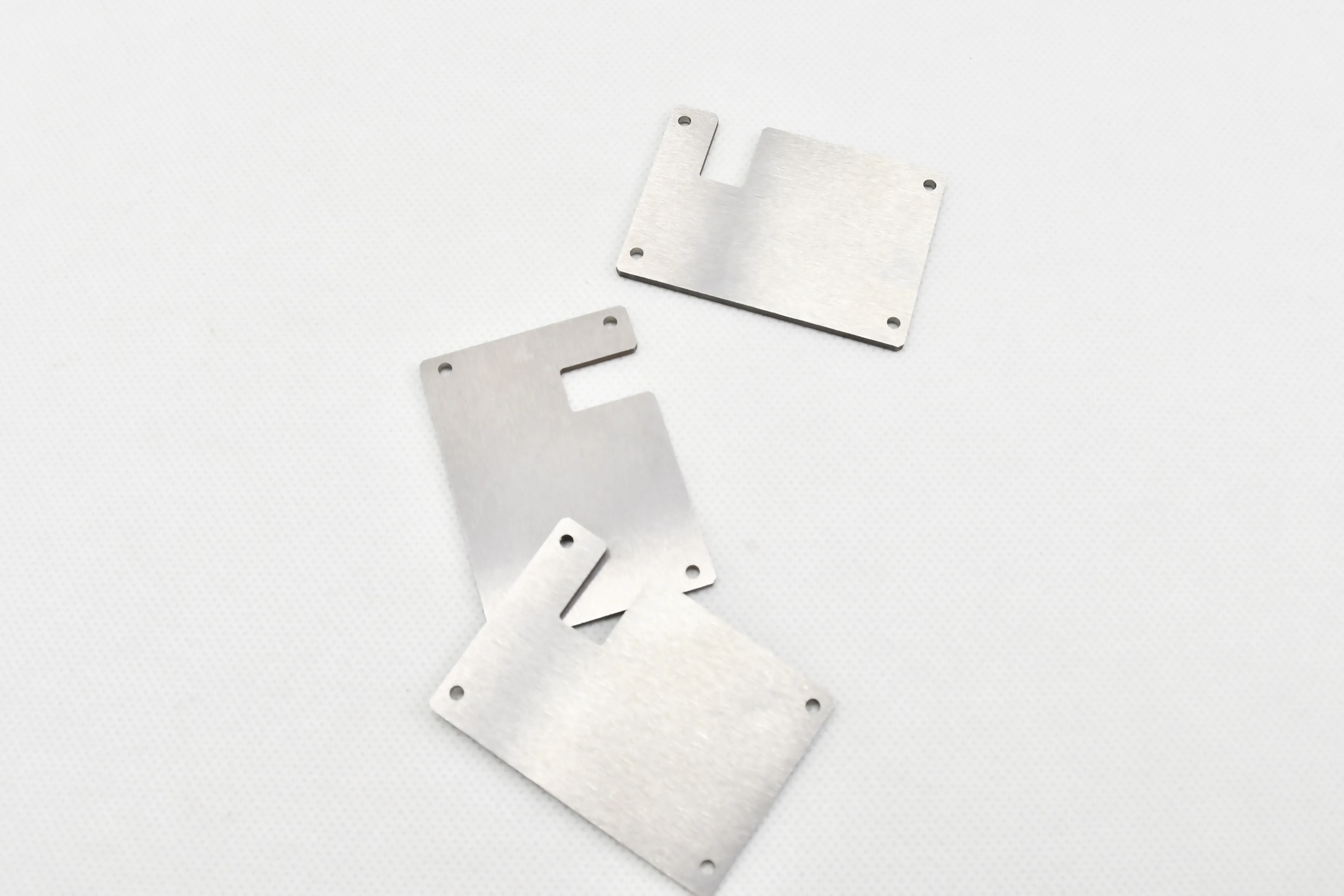
Precision Machining
Use CNC cutting machines, grinders, and drilling machines to process the sintered blank. The key is to control the thickness tolerance (±0.1 mm) and flatness of the panel, and process installation holes, grooves, or edge chamfers according to customer drawings.
For panels that need to be assembled into shielding equipment, precision machining ensures the matching accuracy of the connection structure.
Surface Treatment
Anti-corrosion treatment: Carry out electroplating (nickel plating, zinc plating) or passivation on the panel surface to improve corrosion resistance and prevent oxidation in humid environments.
Surface polishing: For panels used in medical or precision equipment scenarios, polish the surface to reduce surface roughness (Ra ≤0.8 μm) and improve appearance quality.
Quality Inspection
Test core performance indicators: density (16.5–18.5 g/cm³), radiation shielding efficiency (test X-ray/γ-ray attenuation rate), dimensional tolerance, and mechanical strength.
Conduct leak detection for nuclear industry applications to ensure no radiation leakage risks.